


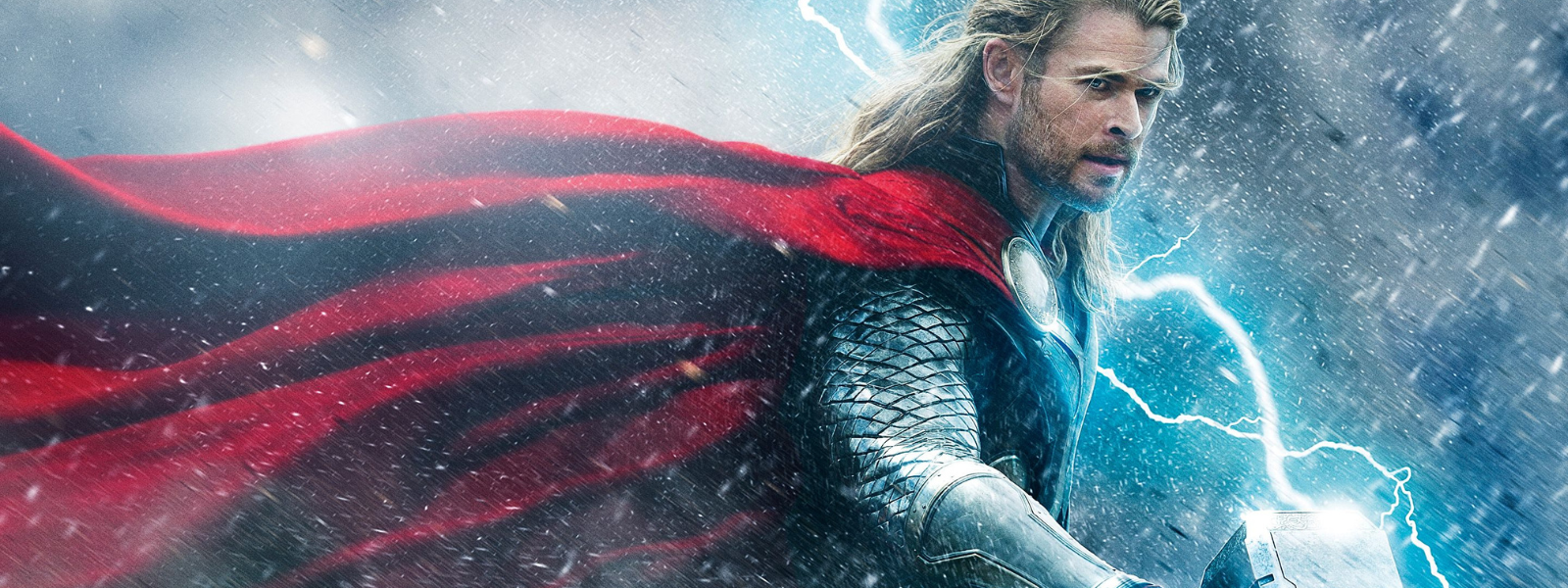
Review – Thor: The Dark World
Director – Alan Taylor
Starring – Chris Hemsworth, Natalie Portman, Tom Hiddleston, Christopher Eccleston, Kat Dennings, Anthony Hopkins, Idris Elba, Stellan Skarsgård and Rene Russo
Runtime – 1 hour and 52 minutes
Release date – 8th November 2013
Certificate – 12A
Plot – When the Dark Elves attempt to plunge the universe into darkness, Thor must embark on a perilous and personal journey that will reunite him with doctor Jane Foster.
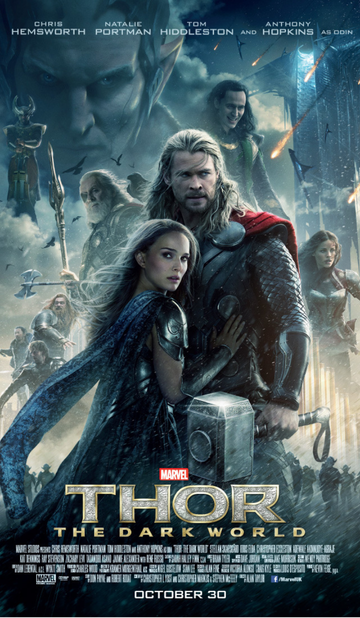
Following the enormous success of The Avengers, Marvel had the difficult task of bringing Thor back into his own corner of the MCU while also continuing the wider narrative of the franchise. Like the first movie, Thor: The Dark World opens with a large amount of exposition explaining an ancient war between the Asgardians and the Dark Elves, introducing the dangerous Aether and Christopher Eccleston’s Malekith. It is very much a setup-heavy opening, throwing mythology, cosmic lore and fantasy terminology at the audience almost immediately. While it does establish the stakes and expands the mythology of this side of the MCU, it never feels particularly gripping. Compared to some of Marvel’s stronger openings, this one lacks energy and urgency, almost feeling like homework before the film can properly begin.
Unfortunately, Malekith himself is a huge part of the problem. Despite Christopher Eccleston being a fantastic actor, the character is easily one of the most forgettable villains in the entire MCU. There is simply nothing memorable about him beyond his appearance and vague desire to return the universe to darkness. Marvel villains were still a weak point during this era, and Thor: The Dark World suffers heavily because its antagonist never commands attention. He lacks charisma, menace and personality, especially when compared to Loki, who completely steals the spotlight every time he appears on screen. Even now, years later, Malekith feels less like a character and more like a plot device to move the Infinity Saga forward.
I must admit that the more mythical and fantasy-driven side of the MCU has never been my personal favourite. That is entirely down to preference rather than quality because the Thor movies absolutely have strengths, but I’ve always gravitated more toward the grounded espionage, sci-fi or character-driven entries in the franchise. Even so, there is still something undeniably unique about Thor’s world. The design of Asgard remains one of the film’s strongest elements. The mix of grand golden architecture, advanced technology, ancient mythology, regal costumes and formal Shakespearean-style dialogue gives this world a distinct identity unlike anything else in the MCU. The ships, weapons and environments create a fascinating blend of fantasy and science fiction that visually separates these films from the rest of Marvel’s catalogue.
Chris Hemsworth also feels far more comfortable in the role by this point. After the first Thor movie and The Avengers, his confidence as the character has noticeably grown. He fully embodies the humour, arrogance, charm and strength of Thor in a way that feels effortless now. There is a much more natural presence to his performance compared to the slightly stiffer approach in the first film. Hemsworth’s chemistry with the cast also continues to improve, especially during the lighter comedic moments that help balance the heavier fantasy elements.
Natalie Portman is also much more central to the story this time around, with Jane Foster becoming directly tied to the threat of the Aether. While the romance between Thor and Jane still lacks some of the emotional chemistry needed to fully carry the movie, Portman does a solid job with the material she is given. The film at least gives Jane more importance beyond simply being a love interest, making her feel genuinely involved in the larger stakes of the story. Her interactions with Thor and Loki also add some entertaining moments, particularly once the film leans more into the awkward humour of these characters colliding worlds.
However, one thing that Thor: The Dark World noticeably misses is Kenneth Branagh’s directing style from the first movie. Branagh brought a theatrical, Shakespearean quality that elevated the original film and gave it a unique tone. With Alan Taylor taking over directing duties here, the sequel feels much more like a standard blockbuster action film. Taylor had mostly directed television before this project, and at times the movie genuinely feels smaller and less cinematic than it should. Some scenes lack visual flair, emotional weight or dramatic impact, especially considering the scale of the story being told. The humour is also slightly inconsistent throughout the film. Some jokes land really well, particularly the banter between Thor and Loki, while other comedic moments feel forced and undercut the tension. Overall though, I do think the film mostly finds a decent balance between fantasy drama and Marvel-style humour.
That being said, the performances across the board remain strong. Idris Elba is given far more to do this time around, and Heimdall finally feels like an important presence rather than just someone standing guard near the Bifrost. Elba brings so much gravitas and coolness to the role that every scene with him instantly has more energy. Tom Hiddleston is once again excellent as Loki, continuing to prove why he became one of Marvel’s standout characters. Loki’s grief, manipulation, sarcasm and unpredictability all make him infinitely more compelling than the main villain. The film is at its absolute best whenever Thor and Loki share the screen together.
Frigga’s death is also one of the few moments where the movie genuinely slows down and allows the emotional weight to breathe. Her funeral sequence is probably the most visually beautiful scene in the entire film. The music, the lanterns drifting across the water and the atmosphere across Asgard create a rare sense of stillness and heartbreak that the movie needed more of. Loki silently reacting in his cell is easily one of Tom Hiddleston’s best moments in the film because you can feel the genuine grief and rage underneath the character’s usual mask of sarcasm and manipulation. It is scenes like this that remind you there is a far stronger emotional story hidden within the movie than the screenplay sometimes allows.
The sequence where Thor and Loki reluctantly work together is easily the highlight of the entire movie. Their uneasy alliance creates tension, humour and emotional depth that the rest of the story sometimes lacks. What makes it work so well is that the film does not suddenly forgive Loki for everything he did in The Avengers. There is still distrust and resentment there, but you can also see the beginning of his redemption arc forming underneath the surface. Hemsworth and Hiddleston bounce off each other brilliantly, creating some genuinely entertaining moments while also grounding the emotional side of the story. The illusion sequence involving Loki pretending to be Captain America is still one of the funniest moments in early MCU history.
The film also has a frustrating habit of revealing things too early. One particular “twist” is telegraphed far too obviously, which unfortunately weakens the emotional payoff later in the film. Marvel clearly wanted audiences to be shocked, but the way the scene is presented makes the reveal predictable almost immediately. It is one of several examples where the script feels weaker than the talent involved. The overall story is serviceable, but it never reaches the emotional or narrative heights the film seems to be aiming for.
Still, Thor: The Dark World deserves credit for its action. The final battle jumping between different worlds and dimensions is visually creative and delivers the kind of large-scale spectacle Marvel has always excelled at. Watching characters and objects suddenly shift between environments mid-fight gives the climax a chaotic energy that helps elevate the finale. Even if the emotional stakes are not particularly strong, the visuals and pacing keep it entertaining. Unfortunately, Malekith himself is defeated far too easily, which only reinforces how underwhelming he is as a villain. After all the buildup surrounding the Aether and the threat he poses, his downfall feels surprisingly anticlimactic.
Despite its flaws, I still think Thor: The Dark World is overhated. The story is definitely weaker than many MCU films, and it lacks the identity and confidence of the stronger entries in the franchise, but it is nowhere near the disaster some people claim it is. The acting is consistently good, the action is entertaining, the world-building remains visually unique and Loki continues to carry every scene he is in. The mid-credits scene is also excellent, teasing both the Infinity Stones and setting up Guardians of the Galaxy in a way that felt genuinely exciting at the time. Thor: The Dark World may never rank among Marvel’s best films, but it still plays an important role in Thor’s journey and the wider Infinity Saga. Beneath the weak villain and uneven storytelling is a genuinely entertaining fantasy adventure elevated by strong performances, impressive spectacle and the unforgettable chemistry between Thor and Loki.