


Review – Avatar: The Way of Water
Director – James Cameron
Starring – Sam Worthington, Zoe Saldaña, Sigourney Weaver, Kate Winslet, Stephen Lang and Cliff Curtis
Runtime – 3 hours and 12 minutes
Release date – 16th December 2022
Certificate – 12
Plot – Jake Sully and Ney’tiri have formed a family and are doing everything to stay together. However, they must leave their home and explore the regions of Pandora. When an ancient threat resurfaces, Jake must fight a difficult war against the humans.

REVIEW:
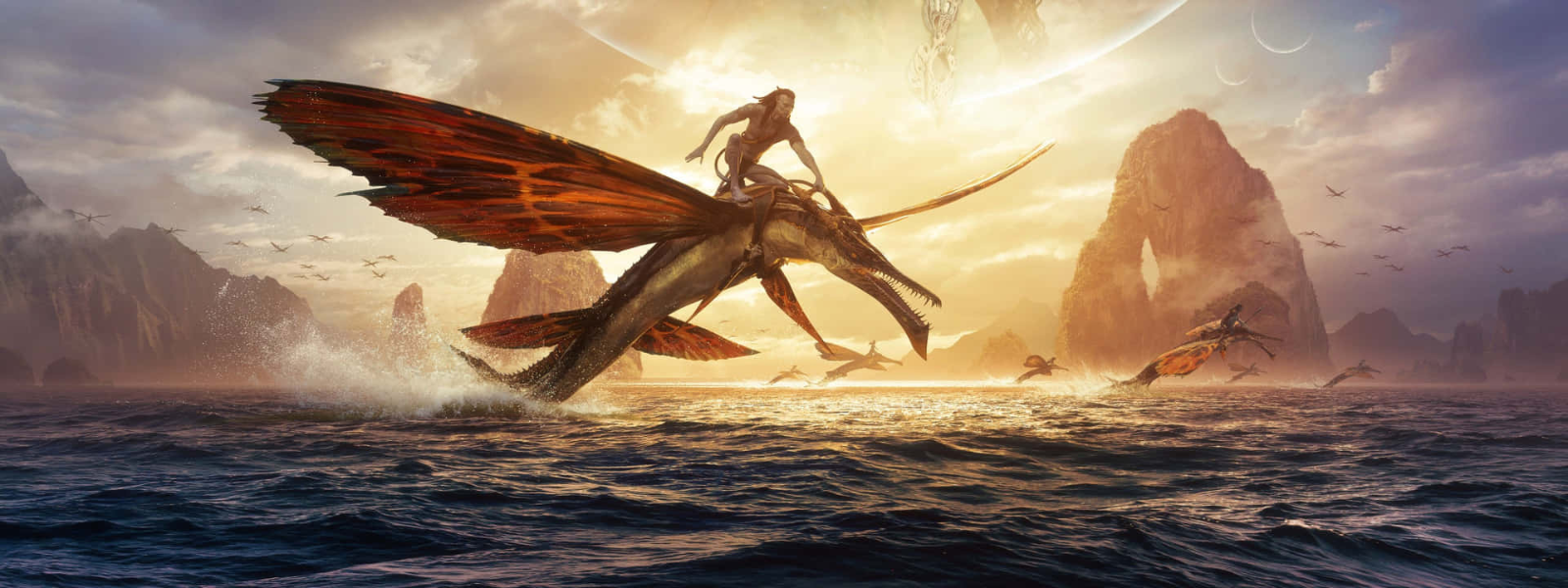
Avatar: The Way of Water arrives carrying an almost impossible weight of expectation, not just because it follows one of the highest-grossing films of all time, but because James Cameron disappeared for 13 years to make it. That absence makes sense the moment the film opens. The CGI here isn’t just an improvement, it’s a generational leap. Cameron clearly spent over a decade developing technology specifically to make Pandora’s oceans feel tangible, and the result is staggering. More than once, I genuinely needed a reality check to remind myself I wasn’t underwater on another planet.
The film wastes absolutely no time getting its story moving. Within the first ten minutes, we’re fully reoriented: Jake and Neytiri now have a family, humanity has returned to Pandora, and war between the two species has reignited. It’s efficient storytelling, almost blunt in how quickly it sets the stakes, and it allows the film to open at a confident sprint rather than a slow world-building crawl. Cameron trusts that we remember Pandora, and for the most part, that trust pays off.
Exploring new locations is one of the film’s biggest pleasures. Pandora still feels vast, and the introduction of new environments keeps it from feeling like a retread. The oceanic regions are a visual triumph, but even Bridgehead City, the human stronghold, looks fantastic. Seeing a fully realised human city on Pandora is strangely compelling. That said, the absence of Unobtanium is baffling. It was the entire reason humans came to Pandora in the first film, and its complete omission here feels less like a deliberate shift and more like a loose thread Cameron simply chose not to pull.
The decision to bring back Quaritch is one that mostly works. He was a strong villain in the original, and his return carries a dark, self-aware edge, especially when he revisits the site of his own death and casually crushes his former human skull. It’s a striking moment that reinforces the film’s themes of identity and rebirth. Quaritch remains one of the most engaging forces in the story, and the movie noticeably improves whenever he’s driving the action.
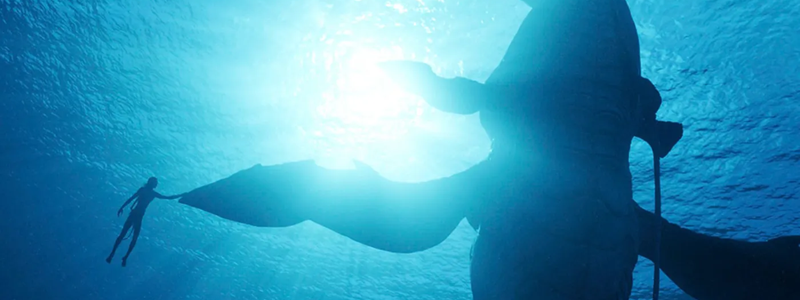
Jake’s choice to move his family for their protection takes the story across the ocean to the Sea Clan, and this is where The Way of Water truly differentiates itself. The Reef People, with their distinct physiology, culture, and relationship to the sea, are fascinating to watch. The new sea creatures are beautifully designed, and the shallows and sandy seabeds are rendered with such crisp, vibrant colour that the whole film sometimes feels like an impossibly expensive advert for a summer holiday on a tropical island.
Unfortunately, the film stumbles badly when it comes to dialogue. The Sully children, in particular, are saddled with some painfully cringeworthy lines. While it makes sense that they speak English learned from their father, their relentless use of “bro” and “cuz” quickly becomes grating. It’s repeated so often that it pulls you out of scenes and undercuts the emotional weight Cameron is clearly aiming for.
Narratively, the story simply isn’t as compelling as the first film. Avatar worked because it had a clear, focused conflict and a strong emotional arc as Jake learned the ways of the Na’vi and grew closer to Neytiri. Here, the plot largely revolves around Quaritch searching for Jake, alongside a late and oddly handled subplot involving humans harvesting Amrita from the brains of the tulkuns. It feels like a watery remix of Unobtanium, less interesting and less urgent. A lengthy middle stretch focuses on the Sully family adapting to life in the ocean, and while visually stunning, it brings the story to a crawl. By the time the movie ends, I can’t honestly say I was desperate to see the next chapter. The fatigue had already started to creep in.
Things do improve once Quaritch begins targeting the sea villages, and from that point on the film regains its intensity. Nearly every frame could double as a screensaver, and the finale delivers pure Cameron spectacle. Jake and Neytiri tearing through humans and Avatars aboard a sinking ship is undeniably badass, and yes, James Cameron clearly still loves sinking ships. The final confrontation between Jake and Quaritch is solid, but the resolution as a whole feels slightly anticlimactic. Rewatching The Way of Water after recently seeing Fire and Ash highlights another issue: the long gaps between sequels. It’s important to revisit the previous films before watching the next instalment, as too much time passes for key characters and moments to remain fresh. The Way of Water is a breathtaking technical achievement, but it also proves that even the most stunning world in cinema needs more than beauty to keep you fully invested.
I enjoyed the original Avatar film not really sure about the ones that followed.