


Review – Disclosure Day
Director – Steven Spielberg
Starring – Emily Blunt, Josh O’Connor, Colin Fifrth, Eve Hewson, Colman Domingo and Russell Wyatt
Runtime – 2 hours and 25 minutes
Release date – 10th June 2026
Certificate – 12
Plot – A meteorologist and a cybersecurity expert find themselves at the center of a movement to expose the government’s cover-up of extraterrestrial secrets.
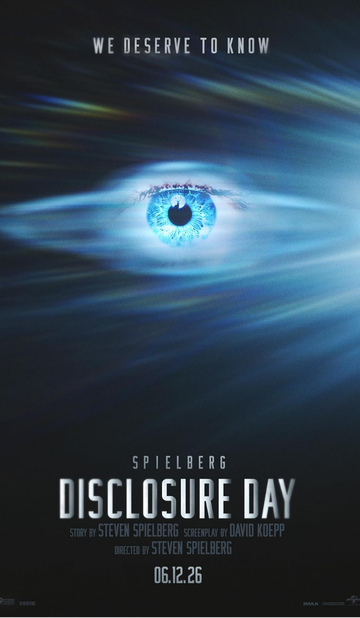
There are bad films, and then there are films that frustrate you because you can see the ingredients for something far more compelling. Disclosure Day falls firmly into that category. On paper, a Steven Spielberg science-fiction drama about first contact and decades of government secrecy sounds like exactly the kind of film I should love. Yet for much of its lengthy runtime, I found myself struggling to stay invested. There were occasional moments that grabbed my attention and reminded me why Spielberg remains one of cinema’s greatest storytellers, but those moments were few and far between. Instead, I spent most of the film waiting for it to become something it never quite managed to be. That’s what makes Disclosure Day such a difficult movie to review. I wasn’t angry, disappointed or even particularly underwhelmed when the credits rolled. I was simply left wondering why a film with this premise, this cast and this director ended up being so surprisingly forgettable.
Perhaps that frustration is magnified because this is Steven Spielberg. Expectations are naturally higher when you’re talking about the man who gave us Jaws, E.T., the Indiana Jones series, Schindler’s List, Saving Private Ryan and, of course, my all-time favourite film, Jurassic Park. His filmography is one most directors could only dream of, and even his lesser works usually contain something memorable. Disclosure Day isn’t his worst film by any means, but compared to the incredible standard he has set over the decades, this sits surprisingly low down the list. What’s frustrating is that Spielberg’s fingerprints are all over it. There are flashes of wonder, moments of humanity and ideas that remind you why he is one of the greatest filmmakers who has ever lived. They just never come together in the way you’d hope.
The biggest problem is the pacing. This movie simply did not need to be this long. In all honesty, it felt like a four-hour film. I checked my watch multiple times and that’s something I almost never do. The issue isn’t necessarily the runtime itself but the lack of progression. There are long stretches where it feels as though characters are simply moving from one location to another without anything substantial happening in between. Conversations repeat information we already know, side plots drift in and out, and the story often feels like it’s delaying the moments audiences have actually come to see. There’s undoubtedly a much tighter film hidden somewhere in the edit. Had Spielberg trimmed this down to around two hours, or perhaps even ninety minutes, I think the experience would have been significantly stronger.
Thankfully, there are plenty of positives, beginning with Emily Blunt. As someone who considers her my favourite actress working today, I had high expectations, and she absolutely delivers. She gives the film its emotional core, perfectly capturing the confusion and trauma surrounding these extraordinary events before gradually evolving into someone driven by determination and purpose. One scene involving a panic attack is particularly remarkable. It’s raw, vulnerable and completely believable. Even when the story around her begins to lose momentum, Blunt never does. She elevates every scene she’s in and reminds you why she’s one of the finest performers working today.
Josh O’Connor gives a strong performance as Daniel, although much of his storyline revolves around being pursued by a mysterious government organisation. I was expecting more alien encounters and larger science-fiction set pieces, but much of the movie instead consists of characters on the move, travelling from place to place while being hunted. Outside of an exciting train sequence and a car chase, both of which are heavily featured in the trailers, there isn’t much action or suspense to maintain the audience’s investment. In fact, if you haven’t seen the trailers, I’d strongly recommend avoiding them because they reveal far too much. Although perhaps that’s doing audiences a favour.
I also enjoyed the appearance of the aliens themselves. Spielberg doesn’t reinvent the wheel here. They’re exactly what most people imagine when they think of extraterrestrials: large black eyes, elongated egg-shaped heads and slender bodies. Yet they look believable. There is a realism to them that makes their appearances genuinely intriguing, and whenever they appear the movie instantly becomes more engaging. Alongside them are three mysterious alien devices that effectively act as the film’s MacGuffins. They lead to some genuinely interesting scenes, allowing Colin Firth’s character to enter people’s minds and enabling Emily Blunt to make herself and others invisible. The problem is that the film never really explains what these objects are or what they can actually do. They simply appear whenever the plot needs them, making them feel less like advanced alien technology and more like convenient storytelling tools.
Unfortunately, I can’t say the same for Jane, played by Eve Hewson. This criticism has nothing to do with Hewson herself, who gives a perfectly respectable performance, but Jane is one of the most unnecessary characters I can remember seeing in recent years. I honestly struggled to understand why she was part of the story. If her purpose was to explore the religious and philosophical questions raised by the alien presence, then those ideas could easily have been incorporated into Emily Blunt’s character instead. Doing so would have strengthened the emotional core of the film and removed an entire subplot that adds very little to the overall narrative.
Ironically, my favourite part of Disclosure Day arrives in the final twenty minutes, and not because it suddenly transforms into an action movie. In fact, quite the opposite. The film finally stops running and starts focusing on the thing that matters most. Emily Blunt’s character goes live on air and reveals to the world that extraterrestrial life exists, exposing decades of government secrecy in the process. It’s a fascinating idea and one that Spielberg handles with genuine emotion and scale. For the first time, the film finally feels focused. Questions about truth, fear and humanity’s place in the universe suddenly become compelling. It left me wishing the entire movie had possessed this same confidence. As effective as those closing moments are, I couldn’t help but think they could have been even more powerful had the preceding two hours done a better job building towards them.
And perhaps that’s my biggest takeaway from Disclosure Day. I’m still not entirely sure what Spielberg was trying to say. The film hints at a world on the brink of catastrophe, perhaps even World War Three, and there seems to be a message about empathy and understanding. But if that’s the case, the message gets lost somewhere along the way. There are fascinating themes buried beneath the surface, but they never fully emerge.
In many ways, Disclosure Day is more frustrating than outright bad because I admired it more than I actually enjoyed it. There are scenes I’ll remember, performances I loved and moments where Spielberg’s brilliance shines through. But I also know this is probably a film I’ll revisit years from now not because I loved it, but because I’ll wonder if I missed something. Maybe a second viewing will reveal the masterpiece Spielberg was reaching for. Right now, though, I can’t escape the feeling that somewhere inside Disclosure Day is a truly great science-fiction film that never quite managed to find its way to the screen. And coming from one of my favourite directors, that’s a disappointment I feel more than I expected.