


Review – Better Man
Director – Michael Gracey
Starring – Robbie Williams, Raechelle Banno, Jonno Davies, Steve Pemberton, Damon Herriman, Alison Steadman and Frazer Hadfiel
Runtime – 2 hours and 14 minutes
Release date – 26th December 2024
Certificate – 15
Plot – The story follows Robbie Williams’ journey from pop sensation to personal struggles and his inspiring comeback in the music industry.
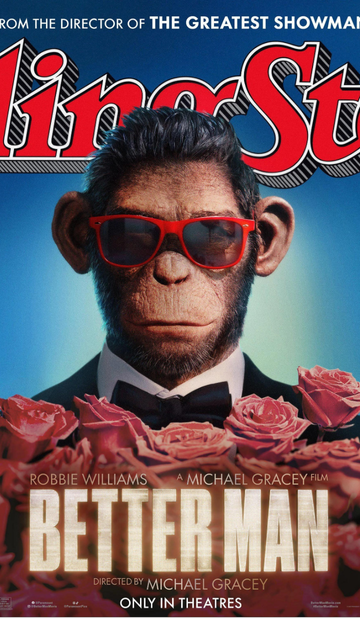
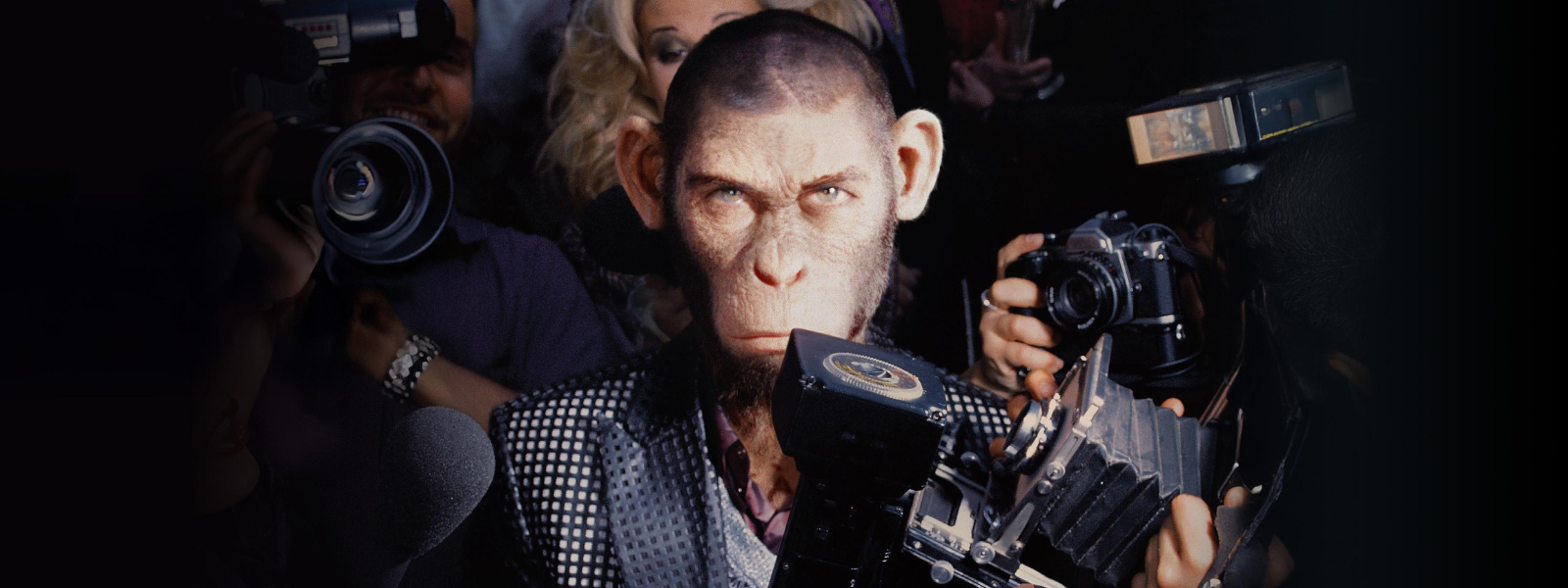
How do you make a music biopic stand out in a genre that has become increasingly crowded and formulaic? If you’re Robbie Williams and director Michael Gracey, the answer is apparently to turn one of Britain’s biggest pop stars into a CGI ape. When I first saw the trailer for Better Man, I have to admit I was sceptical. A biopic about Robbie Williams sounded interesting enough, but the decision to portray him as a CGI ape felt more like a gimmick than a storytelling choice. I wasn’t convinced it was going to work. Having now watched the film, I’m happy to admit I got that one completely wrong. Not only does it work, but it helps create one of the most distinctive and memorable music biopics we’ve seen in years.
The ape concept isn’t simply there to make the film look different. It’s rooted in Robbie Williams’ own perception of himself. Throughout his career, Robbie has often described feeling like an outsider despite standing in front of thousands of adoring fans. The decision to portray him as an ape serves as a visual representation of how he viewed himself throughout much of his career. Despite becoming one of the biggest entertainers in the world, Robbie often saw himself as someone different from everyone around him, constantly battling insecurity and self-doubt. The ape becomes a powerful symbol of that self-perception, allowing the film to explore his inner struggles in a way that a traditional biopic simply couldn’t.
Perhaps the greatest compliment I can give the visual effects is that after ten minutes, you genuinely stop noticing that Robbie is an ape at all. The character becomes so emotionally believable that the effect simply melts into the background. In fact, the more I thought about it, the more I appreciated how clever the concept really is. The genius of the ape isn’t just the symbolism; it’s the emotional distance it creates. Even during the moments where Robbie is adored by thousands of screaming fans, he’s visually separated from everyone around him. While the world sees a superstar, he sees something different staring back at him. That constant disconnect reinforces the insecurities and self-doubt that followed him throughout much of his career. It’s a fascinating creative decision that elevates Better Man above many of its peers.
Of course, none of this would work without a strong performance at the centre of it all, and Jonno Davies delivers exactly that. Despite spending the entire film hidden behind motion-capture technology, Davies perfectly captures Robbie’s swagger, confidence, charisma and larger-than-life personality. Just as importantly, he nails the darker moments too. Whether Robbie is riding the highs of superstardom or spiralling through addiction and self-destruction, Davies brings a level of vulnerability that makes the character feel authentic throughout. It’s an impressive performance and one that deserves far more recognition than it has received.
One of the questions I found myself asking while watching Better Man was whether it would resonate as strongly with audiences outside of the UK. There’s no doubt that Robbie Williams and Take That achieved global success, but Robbie’s music feels particularly embedded within British culture. Many of these songs have become part of the soundtrack of people’s lives here in the UK. As certain tracks begin to play, there’s an immediate emotional connection that comes from years of familiarity. I do wonder whether audiences in other countries experience those moments in quite the same way. If you’re reading this review and you’re not British, I’d genuinely love to hear your thoughts because it’s something I found myself considering throughout the film.
One of my biggest concerns going into Better Man was that the unusual premise would result in a film that never took itself seriously. Thankfully, that couldn’t be further from the truth. Beneath the creative visuals lies a surprisingly raw and honest exploration of fame, addiction and mental health. The film charts Robbie’s rise, fall and eventual rebirth with an honesty that often feels more uncomfortable than many traditional biopics. It doesn’t shy away from the uglier aspects of his life and shows the damage that success can inflict on someone already battling their own inner demons. At times, it feels even more brutally honest than many of its contemporaries.
Another area where Better Man excels is its visual presentation. This is not a standard biopic in any traditional sense. The musical numbers play out far more like a full-blown musical than a conventional retelling of Robbie Williams’ life. In that respect, it feels much closer to Rocketman than Bohemian Rhapsody. Songs aren’t always presented in chronological order, nor are they necessarily performed in the context of concerts or recording sessions. Instead, they’re woven into key emotional moments of Robbie’s life. Michael Gracey’s experience directing The Greatest Showman is evident throughout. The choreography is spectacular, the camerawork is ambitious and dynamic, and several sequences blur the line between fantasy and reality in genuinely exciting ways. The film constantly feels larger than life, mirroring the scale of Robbie’s career itself.
The standout sequence arrives relatively early in the film following Take That’s record deal. Set to Rock DJ, what follows is an exhilarating dance number through Regent Street that perfectly demonstrates everything the film does well. The energy is infectious, the choreography is brilliantly executed and the camera glides effortlessly through the chaos, creating a sequence that feels both technically impressive and immensely entertaining. It’s one of those scenes where you can feel the confidence of the filmmakers behind the camera, and it’s arguably the moment where Better Man truly announces what kind of film it wants to be.
As for the music itself, every number lands. Whether it’s a massive spectacle or a quieter emotional moment, each song serves a purpose within the narrative. Naturally, everyone will have their personal favourite. Mine is Angels, although I freely admit that’s partly because it’s my favourite Robbie Williams song anyway. Even so, the way it’s incorporated into the story gives it genuine emotional weight. More importantly, there isn’t a weak musical sequence anywhere in the film. Every song helps drive Robbie’s journey forward while simultaneously reminding us why his music connected with so many people in the first place.
If the film has one weakness, it’s the amount of time spent exploring Robbie’s relationships with the other members of Take That. We see their rise to fame and understand their importance in his story, but I found myself wanting more insight into those dynamics. The focus remains firmly on Robbie throughout, which makes sense given the nature of the project, but it does leave some of those relationships feeling underdeveloped. Whether that was a deliberate creative choice by Robbie Williams and Michael Gracey or the result of legal limitations, I’m not sure. Either way, it’s the one area where I felt the film could have gone a little deeper.
What surprised me most about Better Man is how sincere it feels. On paper, a biopic starring a CGI ape sounds like an idea that should never work. Yet somehow Michael Gracey and Robbie Williams have transformed what initially appears to be a gimmick into the film’s greatest strength. By embracing such a bold creative choice, they’ve found a way to tell a familiar story through a completely fresh lens.
Better Man isn’t my favourite music biopic, but it’s undoubtedly one of the most unique. It’s emotional, visually spectacular, brutally honest and packed with fantastic music. More importantly, it’s willing to take risks at a time when many biopics feel content to follow the same well-worn formula. What initially looked like a bizarre creative gamble ends up becoming the very thing that makes the film special. Like Robbie Williams himself, Better Man is messy, flawed, unconventional and impossible to ignore. By the time the credits roll, you’re left with a film that dares to be different, embraces its own eccentricity and ultimately delivers one of the most original music biopics of recent years.
Not the type of film I really enjoy but I interesting review.