



Review – Spectre
Director – Sam Mendes
Starring – Daniel Craig, Léa Seydoux, Christoph Waltz, Naomie Harris, Ben Whishaw, Andrew Scott, Ralph Fiennes, Rory Kinnear and Dave Bautista
Runtime – 2 hours and 28 minutes
Release date – 26th October 2015
Certificate – 12A
Plot – A cryptic message from James Bond’s past sends him on a trail to uncover the existence of a sinister organisation named SPECTRE. With a new threat dawning, Bond learns the terrible truth about the author of all his pain in his most recent missions.
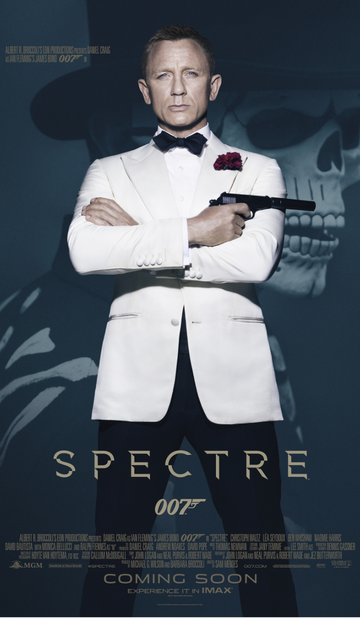
Let’s be honest, Spectre was never going to win everyone over. Following the near-universal acclaim of Skyfall, expectations were sky-high, and for many, this didn’t quite reach them. But here’s the thing, I think Spectre is far better than it’s often given credit for. Not perfect, not the best of the Daniel Craig era, but a bold, ambitious Bond film that dares to tie everything together in a way no Bond film had truly done before.
And it tells you exactly what it is from the very first frame. The gun barrel returns here in full classic fashion, and it feels like a bold statement of intent. While Casino Royale and Quantum of Solace experimented with its placement and style, Spectre brings it back to what audiences instantly recognise—Bond stepping into the centre, the iconic theme surging, and that unmistakable shot fired down the barrel. It’s a moment that doesn’t just open the film, it announces it. This isn’t just another mission, this is a culmination. That’s what makes Craig’s era so enjoyable for me. Unlike the more episodic nature of earlier Bond films, this feels like one continuous story. You can’t just drop into Spectre and expect to get everything out of it. It builds on Casino Royale, Quantum of Solace, and Skyfall, and because of that, it feels bigger, heavier, and more personal.
That sense of momentum carries nicely into the opening sequence in Mexico City. It may not reach the same heights as Skyfall’s unforgettable pre-title sequence, but it’s still a strong and stylish way to kick things off. The Day of the Dead backdrop instantly gives the film scale and atmosphere, while the long tracking shot through the crowds feels unmistakably Bond.
There is no denying that James Bond is the definition of cool, and Craig might be the coolest of them all. The way he casually walks across rooftops in broad daylight, carrying an assault rifle like it’s nothing, is ridiculous on paper but on screen, it just works. He doesn’t force it. He is Bond.
But what really hooks me is the mystery. Bond going rogue after receiving a message from the now deceased M instantly raises questions. Why this target? Why did Bond receive this message after her death? That intrigue pulls you in, and as Bond follows the trail, the film gradually reveals something much bigger than a single mission. It’s not just about stopping a villain, it’s about uncovering the truth behind everything he’s been through.
And this is where I think Spectre deserves far more credit than it gets. The decision to connect all of Bond’s past enemies under one umbrella is bold, and for me, it absolutely works. When Christoph Waltz is finally revealed as Blofeld, and we learn that he’s been orchestrating everything from Le Chiffre to Raoul Silva, it genuinely shocked me. But what elevates it even further is the personal twist. Making Blofeld Bond’s foster brother could have felt forced, but instead, it adds a layer of bitterness and jealousy that reframes their entire conflict. This isn’t just a villain trying to take over the world. This is someone who has built his empire on resentment, someone who has deliberately shaped Bond’s life from the shadows. As he chillingly puts it, “It was all me, James. It’s always been me. The author of all your pain.” He isn’t just behind the chaos, he’s behind Bond’s pain, and while he may not be as outwardly intimidating as Silva, that personal connection makes him just as interesting in a very different way.
That said, Spectre still knows how to have fun with the classic Bond formula. The suits, the cars, the gadgets, the locations, it’s all here, and it looks incredible. But because the film is aiming for something deeper, the more traditional elements don’t always land as well as they should. Bond’s encounter with Monica Bellucci, for example, feels like it comes out of nowhere and plays as a forced moment, almost as if the filmmakers felt the need to tick a box rather than let it develop naturally within the story.
What does work consistently, though, is the supporting cast. Ben Whishaw is brilliant as Q, and his dynamic with Bond brings a lot of warmth and humour to the film. Their back and forth feels effortless, and it helps ground the story when things start to get heavier. That sense of connection extends to the wider MI6 team as well. Seeing Ralph Fiennes’ M, Moneypenny, and Tanner actively involved in the final act makes it feel like a true team effort, which is something we don’t often get in Bond films.
At the same time, not everything is used to its full potential. Dave Bautista’s Hinx is physically imposing and genuinely intimidating, but he feels underutilised. He drops in and out of the story rather than being a constant threat. Still, when he does appear, it leads to some of the film’s best sequences, the Rome car chase, the Austrian pursuit, and the brutal train fight, so his presence, while limited, is definitely felt.
The pacing is another area where opinions will vary. At nearly two and a half hours, I can see why some people might drift, especially with the subplot involving Andrew Scott’s C and the future of intelligence services. It’s an interesting idea, but it does slow the momentum at times. Personally, though, I think the runtime is justified. This is a complex story with a lot to juggle, and I’d rather it take its time than rush through something this ambitious.
There are also moments that genuinely get under your skin. The torture scene might not be as outright brutal as what Bond endured in Casino Royale, but it’s still deeply uncomfortable. The sound of the drill alone is enough to make you wince. And it’s moments like this that remind you just how much this version of Bond has been through, which makes his resilience all the more satisfying to watch.
By the time we reach the ending, there’s a sense of closure but also a feeling that something is missing. It is satisfying, in a way, seeing Bond step away, but it didn’t feel like enough for this version of the character. After everything he’s endured, everything he’s lost, I wanted more. More weight, more finality, more emotion. It feels like the end of a chapter, not the end of a story, and for Daniel Craig’s Bond, that distinction really matters.
Spectre may not reach the heights of Skyfall or Casino Royale, but it’s a film that takes risks, expands the mythology, and brings a level of connectivity that makes this era so compelling. It stumbles at times, no doubt, but when it works, it really works.
And maybe that’s why it’s stuck with me. Because Spectre isn’t just trying to be another Bond film. It’s trying to mean something. It’s trying to tell us that everything Bond has faced wasn’t random, that it was all leading here, all part of something bigger. Whether you buy into that or not will define your experience.
For me, it did. And that made it an experience I won’t forget anytime soon.
Not my favourite film but it was ok .