


Review – War for the Planet of the Apes
Director – Matt Reeves
Starring – Andy Serkis, Woody Harrelson, Steve Zahn, Terry Notary, Amiah Miller and Karin Konoval
Runtime – 140 minutes
Release date – 11th July 2017
Certificate – 12
Plot – When a rogue army of humans kills Caesar’s wife and son, he sets out to exact revenge. But his quest for retribution reveals his darker instincts even as he makes a startling discovery.
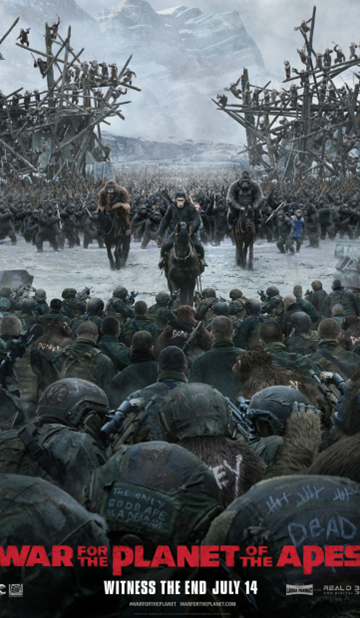
REVIEW:
Coming off the back of Dawn of the Planet of the Apes, I went into War expecting an all-out conflict between humans and apes. What Matt Reeves delivers instead is something far more introspective and, ultimately, far more powerful. This is not a film driven by spectacle for spectacle’s sake. It is a story about revenge, grief, the inability to let go, and the long road to redemption. While it was not the movie I thought I wanted, it turned out to be exactly the movie this trilogy needed to conclude Caesar’s journey.
Reeves returns as director and once again proves he understands that this trilogy lives and dies on character rather than chaos. Set two years after Dawn, the film throws us straight into an escalating struggle for dominance between the remaining humans and the apes, but it does so with discipline and intent. The world feels colder, harsher, and more desperate, mirroring the emotional state of its central character. This is blockbuster filmmaking that values patience and confidence, trusting silence and stillness just as much as explosive moments.
Andy Serkis’ Caesar remains one of the most remarkable performances ever committed to motion capture. In War, we see a version of Caesar that is angrier, more broken, and dangerously close to losing the moral compass that once defined him. Following the murder of his wife and son, Caesar is consumed by vengeance, and watching him battle those inner demons is both gripping and heartbreaking. This is no longer the hopeful leader of Rise, but a leader struggling to recognise himself.
Throughout Caesar’s revenge driven journey, we see how far he has drifted from the belief that apes and humans can coexist. His mistrust of humanity is absolute, shaped by trauma and loss, and it threatens to consume him entirely. Yet it is through the quiet presence of Nova, a mute human child, that the film gently reminds both Caesar and the audience that coexistence is still possible. Without words, Nova becomes a symbol of innocence and hope, challenging Caesar’s growing hatred and reinforcing the idea that survival does not have to come at the cost of compassion.
Woody Harrelson’s Colonel is a chilling antagonist, not because he is theatrical, but because he is convinced he is right. His brutality is driven by fear and survival rather than pure malice, making him an unsettling mirror to Caesar. Both men are willing to cross moral lines in order to protect their kind, and that parallel gives the conflict a depth that elevates it beyond a standard hero and villain dynamic.
One of the film’s most unsettling elements is the evolution of the simian flu. Watching humans regress into a primitive state, stripped of language and identity, is deeply disturbing and adds a genuine sense of horror. These moments are frightening not because of jump scares, but because of what they represent. The slow extinction of humanity as it once existed, unfolding quietly and inevitably.
Visually, War for the Planet of the Apes is stunning. The shift from dense woodland to vast, snow covered landscapes gives the film a bleak, almost biblical tone, reinforcing the sense that this is the end of one world and the beginning of another. It is also a smarter blockbuster than most you will see. The film trusts its audience to read emotion through performance rather than exposition and allows meaning to emerge naturally, proving that spectacle and intelligence can exist side by side.
Despite its bleakness, the film finds room for warmth through Steve Zahn’s Bad Ape. His humour never undercuts the drama but instead provides brief moments of relief and humanity in an otherwise punishing story. By the time the final act arrives, the film delivers the action you want, but with far greater emotional weight and consequence. The ending feels earned, devastating, and deeply moving, serving as a powerful farewell to Caesar and everything these three films have been building towards. When discussing the greatest film trilogies of all time, alongside Star Wars, The Lord of the Rings, The Godfather, and The Dark Knight, Rise, Dawn, and War for the Planet of the Apes belong in that conversation without hesitation.
I have to say that I personally really enjoyed all the Planet of the Ape films.