


Review – Dawn of the Planet of the Apes
Director – Matt Reeves
Starring – Andy Serkis, Jason Clarke, Gary Oldman, Keri Russell, Toby Kebbell, Judy Greer, Terry Notary and Karin Konoval
Runtime – 131 minutes
Release date – 17th July 2014
Certificate – 12
Plot – Caesar, a chimpanzee and leader of the evolved apes, allows a human family into his territory. However, due to a vindictive bonobo, misunderstandings arise between the two species, resulting in war.
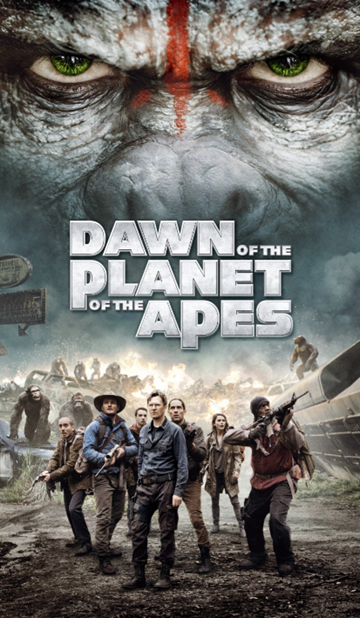
REVIEW:
After the hugely successful and completely unexpected Rise of the Planet of the Apes, excitement had genuinely returned to a franchise that many had written off as finished. I remember going into Dawn of the Planet of the Apes with real anticipation, desperate to see where Caesar’s story would go next. This wasn’t just about spectacle anymore, it felt like a character-driven saga was being carefully built, and Dawn immediately justifies that faith by taking a bold time jump and trusting the audience to fill in the emotional gaps.
Ten years have passed since the events of Rise, with the Simian Flu devastating humanity in the decade that followed. Caesar now leads a thriving ape community hidden deep within Muir Woods National Monument near San Francisco. They have built homes, systems, and a society rooted in order and mutual respect, all while trying to live in harmony with nature. What struck me most is how peaceful these opening moments are, painting the apes not as monsters but as settlers trying to protect what they’ve built. It’s a calm that feels fragile from the very first frame.
Believing they are alone in the world after not encountering humans for at least two years, the apes’ sense of security is shattered when a group of human survivors venture into the woods. This small team, sent from a struggling San Francisco to repair a dam and restore electricity, unintentionally ignites fear and paranoia on both sides. What follows isn’t a simple humans-versus-apes conflict, but a tense psychological standoff over territory, trust, and dominance, eventually spiralling toward an inevitable and tragic war.
This is easily my favourite of the newer Planet of the Apes films, and the one that stands above both Rise and War for me. While Rise laid an excellent foundation, I always felt the human characters were its weakest point, James Franco aside. Dawn, on the other hand, elevates everything. The human characters are more interesting, more morally complex, and feel like genuine participants in the story rather than obstacles for the apes to overcome. The action is bigger and more confident, but it’s the character work that truly sets this film apart.
A huge part of that success comes from Matt Reeves taking the helm as director. Reeves is an incredible visual storyteller, and one of the things I admire most about Dawn is its restraint. He allows scenes to play out with minimal dialogue, trusting body language, framing, and silence to carry the tension. There’s a patience to the filmmaking that makes every confrontation feel earned, and when the violence does erupt, it hits harder because of how long it’s been held back.
One of the film’s greatest achievements is Koba, who I genuinely believe is one of the best movie villains in modern cinema. Toby Kebbell delivers a haunting performance as an ape who knows nothing but pain and hatred at the hands of humans. Unlike Caesar, Koba cannot envision coexistence, only domination. He isn’t a villain driven by ambition, but by trauma, and that makes him terrifying. He becomes the spark that ignites the war, not out of malice alone, but because peace is something he simply cannot comprehend.
The ensemble cast is excellent across the board. James Franco does not return, but Jason Clarke, Gary Oldman, and Keri Russell bring weight and credibility to the human side of the story. Still, this film belongs to Andy Serkis. As Caesar, he is the heart and soul of the entire trilogy. Since the first film, both he and the ape community have grown smarter, their speech more developed but still imperfect, reminding us how early this is in the timeline. Centuries away from the apes of earlier films, yet already deeply human in their emotions and conflicts.
One of my favourite moments in the entire franchise is when Caesar returns to his childhood home. A subtle symbol on the door quietly tells us that Will Rodman (Franco) likely succumbed to the virus, but it’s the discovery of the old video camera that truly lands emotionally. Watching brief footage of Franco teaching baby Caesar sign language is devastating. Despite everything that has changed, that bond still matters, and it reinforces why you never stop rooting for Caesar.
The story is consistently engaging, the action is phenomenal, and the imagery is unforgettable. An ape charging on horseback while firing two machine guns is genuinely horrifying, while the final confrontation between Caesar and Koba is edge-of-your-seat movie magic. Dawn of the Planet of the Apes brilliantly highlights how similar humans and apes truly are, capable of both compassion and destruction. The ending leaves your heart racing, filled with dread and anticipation for what’s to come. I love this movie, and it comfortably sits among my top five favourite films of all time.
Really enjoyed this film.