


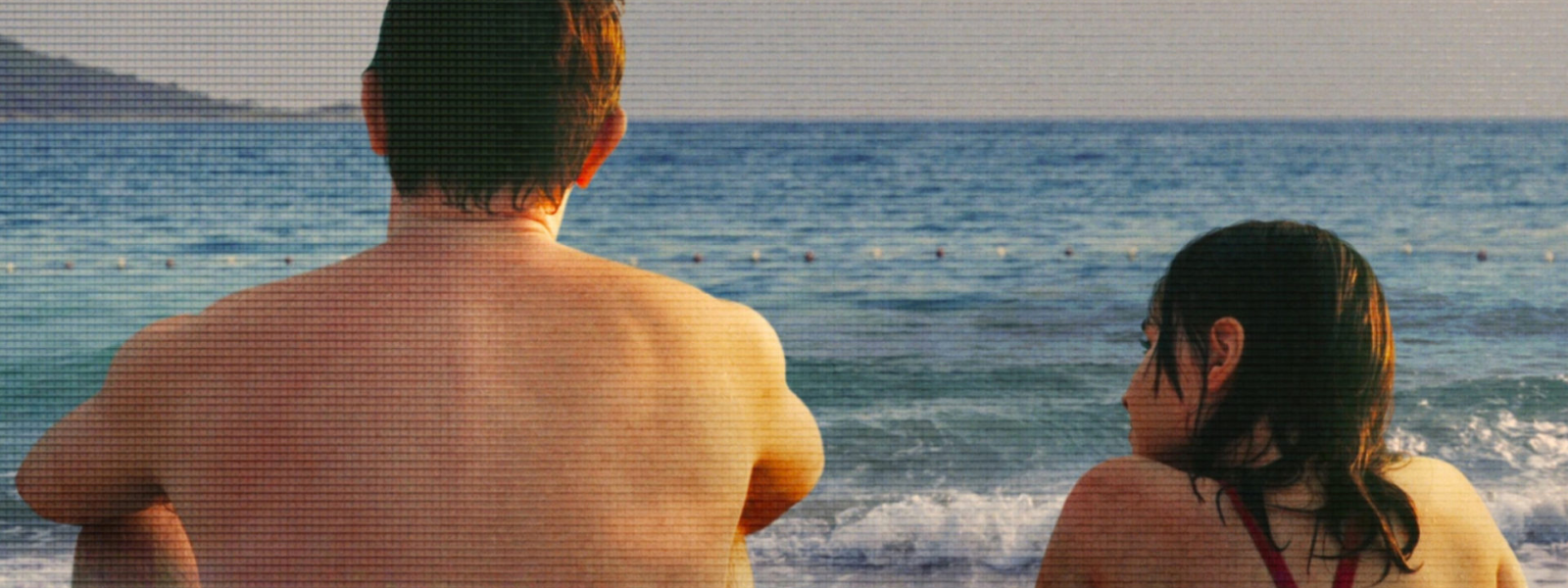
Review – Aftersun
Director – Charlotte Wells
Starring – Paul Mescal, Frankie Corio and Celia Rowlson Hall
Runtime – 1 hour and 42 minutes
Release date – 18th November 2022
Certificate – 12
Plot – Sophie reflects on the shared joy and private melancholy of a holiday she took with her father twenty years earlier. Memories real and imagined fill the gaps between as she tries to reconcile the father she knew with the man she didn’t.
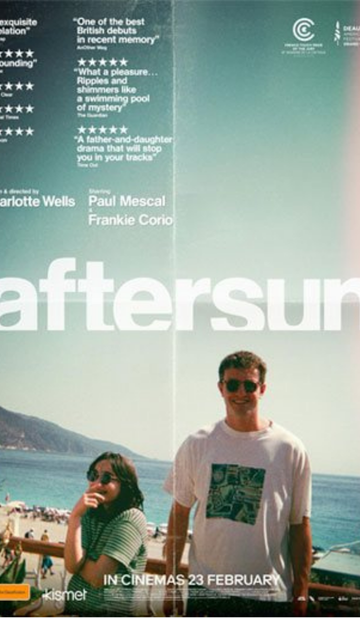
Writing this Aftersun movie review proved more difficult than I expected. There are certain films that you go into expecting to connect with on a much deeper and more personal level than others, and Aftersun was absolutely one of those films for me. As a man who has suffered with depression for many years, I am a huge advocate for men speaking openly about mental illness. Far too many men are afraid to admit that they are struggling, choosing instead to bury their emotions and convince everyone around them that everything is fine.
Because Aftersun appeared to shine a light on exactly that kind of hidden suffering, I genuinely expected this film to hit me incredibly hard. I expected something emotionally devastating that I would recognise pieces of myself in. Unfortunately, despite the importance of what the film is trying to explore, that emotional connection never arrived for me.
Even the synopsis suggested that Aftersun would provide a heartbreaking examination of depression through the memories of a daughter who was simply too young to understand what her father was going through at the time. Sophie reflects on the shared joy and private melancholy of a holiday she took with her father twenty years earlier, using memories both real and imagined to fill in the gaps as she attempts to reconcile the father she remembers with the man she never truly knew. That is such a powerful concept. Children see their parents as Mum or Dad without necessarily understanding the complicated human being underneath that title. Then, as adults, we can look back at moments we once considered completely ordinary and suddenly recognise things that were invisible to us at the time.
Naturally, I expected the film to initially show us the holiday through young Sophie’s eyes before gradually revealing more through the perspective she has gained as an adult. I wanted to see the difference between what eleven year old Sophie remembered and what adult Sophie now suspects was happening beneath the surface. Instead, Aftersun largely remains within those fragmented childhood memories, with adult Sophie almost becoming a distant observer trying to reconstruct something that can never truly be completed. I understand that perhaps this absence is exactly the point. Sophie cannot suddenly access the moments she never witnessed, just as anyone who loses somebody can spend years looking backwards and searching memories for signs they missed. Maybe we are supposed to share her frustration, piecing together fragments of Calum without ever being allowed completely inside his head.
I can appreciate that intention, and in some ways it makes the concept even more tragic. Adult Sophie is essentially trying to solve a puzzle with pieces that no longer exist. She can replay the camcorder footage, revisit conversations and reconstruct moments in her imagination, but she can never ask Calum the questions she now understands she should have asked. However, understanding why a filmmaker has made a creative choice does not automatically mean that choice connects with you. For me, keeping Calum at such a distance meant that I understood Sophie’s grief intellectually without ever truly feeling the weight of the man she was grieving. Perhaps that frustration is exactly what Charlotte Wells wants us to experience, but it nevertheless created an emotional barrier for me.
None of that criticism should be directed towards Paul Mescal or Frankie Corio because both are fantastic as Calum and Sophie. Their relationship feels wonderfully natural, and there are moments where you genuinely forget that you are watching two actors performing scripted scenes. Corio captures the innocence and curiosity of an eleven year old girl beautifully, while Mescal gives Calum a quiet vulnerability that constantly suggests there is something underneath the surface. Considering the subject matter, both performers had an enormous amount to carry, and their performances are beautiful. My issue with Aftersun has never been the performances. My issue is that I do not think the story gives those performances enough room to fully expose the darkness that supposedly exists beneath this seemingly ordinary father and daughter holiday.
There are glimpses of Calum’s suffering, but for me they are simply too fleeting. We see him break down when he is alone, and there is the deeply troubling sequence in which he walks into the sea, seemingly with little concern for whether he returns. Elsewhere there are references to financial problems, suggestions of a difficult childhood, his drinking and the unexplained injuries on his body. These details clearly exist to build a picture of a man struggling internally, but individually they do not necessarily point towards depression. Financial difficulties, alcohol, injuries and childhood trauma can obviously contribute towards somebody’s declining mental health, but they are not automatically evidence of depression themselves. Having experienced depression personally, perhaps that is why I wanted the film to dig deeper into that internal battle rather than simply asking me to interpret a collection of external clues.
This is where Aftersun sometimes felt like the first half of an incredibly powerful movie to me. What we see is Sophie’s incomplete recollection of going on holiday to Turkey with her dad and gradually recognising, years later, that he was not in a particularly good place. I wanted just a few more glimpses behind the curtain. Show me Calum alone after Sophie has gone to sleep. Show me the effort required to smile at his daughter when everything inside him is telling him to do the opposite. Show me the exhaustion of pretending to be okay because the last person he wants to burden is his child. Someone can laugh, joke, swim and dance with their daughter while privately feeling like they are falling apart. Depression does not always announce itself, particularly with men who have become incredibly good at hiding it. Exploring that contrast a little further could have transformed my connection with Calum without taking away the ambiguity surrounding him.
The camcorder footage is one of the film’s strongest ways of exploring adult Sophie’s relationship with those memories. The recordings give her something tangible from a period of her life that otherwise exists only through an unreliable childhood perspective. A smile captured on camera becomes something she can analyse twenty years later. A seemingly insignificant expression can suddenly become another possible clue. There is something painfully human about searching old footage for answers that simply are not there, believing that if you look closely enough you might finally find the moment that explains everything. Aftersun understands that sometimes there is no single moment and no definitive answer. There are only fragments, and those fragments can become more painful the longer you stare at them.
Throughout the film we are also shown fragmented images of adult Sophie and Calum seemingly trying to reach one another inside a nightclub, illuminated by aggressive strobe lighting. These sequences are clearly symbolic rather than literal. Calum repeatedly appears and disappears in the darkness, briefly illuminated before being swallowed again, which feels like a visual representation of Sophie’s entire relationship with her memories of him. She can see him, but never clearly enough. She can reach towards him, but never truly hold onto him. I understand what these moments are trying to represent, but because I never formed the connection with Calum that I desperately wanted, I found myself understanding the symbolism more than emotionally feeling it.
That imagery becomes particularly important during the ending. After saying goodbye to Sophie at the airport, Calum remains behind with the camera. He closes it, turns away and walks through a pair of doors into the same strobing darkness we have repeatedly seen throughout the film. It is a haunting image. The holiday ends, the recording stops and her father effectively walks out of the memory. Adult Sophie has spent the film trying to reach backwards through time, searching those memories for the father she now realises she never completely knew, yet she cannot follow him through those doors. Everything beyond them remains inaccessible. I completely understand why that ending has devastated so many viewers. There is no grand revelation because Sophie never received one. There is no final explanation of Calum because she never had the opportunity to truly understand him.
Yet come the end of the movie, I was still left feeling unfulfilled, which I appreciate is a strange thing to say considering the subject matter. I was not expecting answers to every question surrounding Calum, nor did I need the film to explicitly diagnose him or explain everything he was experiencing. What I wanted was a deeper connection with him. I wanted to feel the exhausting contradiction of being a loving father creating happy memories for his daughter while simultaneously fighting something inside himself that she could not possibly comprehend. I understand why Aftersun has connected so profoundly with so many people, and for some viewers its restraint and ambiguity will undoubtedly be exactly why it is so powerful. Art is subjective, though, and sometimes a film can explore a subject incredibly close to you and somehow leave you feeling further away from it than expected.
On a complete side note, one aspect of the film that I absolutely loved was its location. Aftersun was filmed around Ölüdeniz in Turkey, somewhere I have been on holiday at least five times. Seeing somewhere so familiar on screen gave the film an unexpected personal connection for me. Recognising the scenery and atmosphere immediately brought back memories of my own holidays there, and there is something strangely fitting about that. Here I was watching a movie entirely concerned with the emotional power of memories from a Turkish holiday while the location itself was triggering memories of my own. Thankfully mine are considerably happier, but it gave the setting an added significance that will obviously be unique to my experience watching the film.
Ultimately, Aftersun is a difficult film for me to review because I admire what it wants to say considerably more than I connected with how it says it. Paul Mescal and Frankie Corio are brilliant, their father and daughter chemistry is beautiful, and the concept behind the movie is incredibly important. I understand why Calum remains elusive. I understand why adult Sophie cannot simply uncover the truth, and I understand why the answers she desperately searches for remain beyond those doors. But understanding those choices and emotionally connecting with them are two very different things. A story about a daughter looking back and finally recognising the pain her father successfully hid from her could have absolutely broken me. In many ways, I went into Aftersun wanting it to. Instead, I remained on the outside looking in, much like Sophie herself. I wanted this film to devastate me. Instead, when Calum walked through those doors and disappeared into the darkness, I understood why Sophie wanted to follow him, but I never felt the overwhelming need to follow him with her.
Not a film I’ve ever heard of but a hard hitting review.