


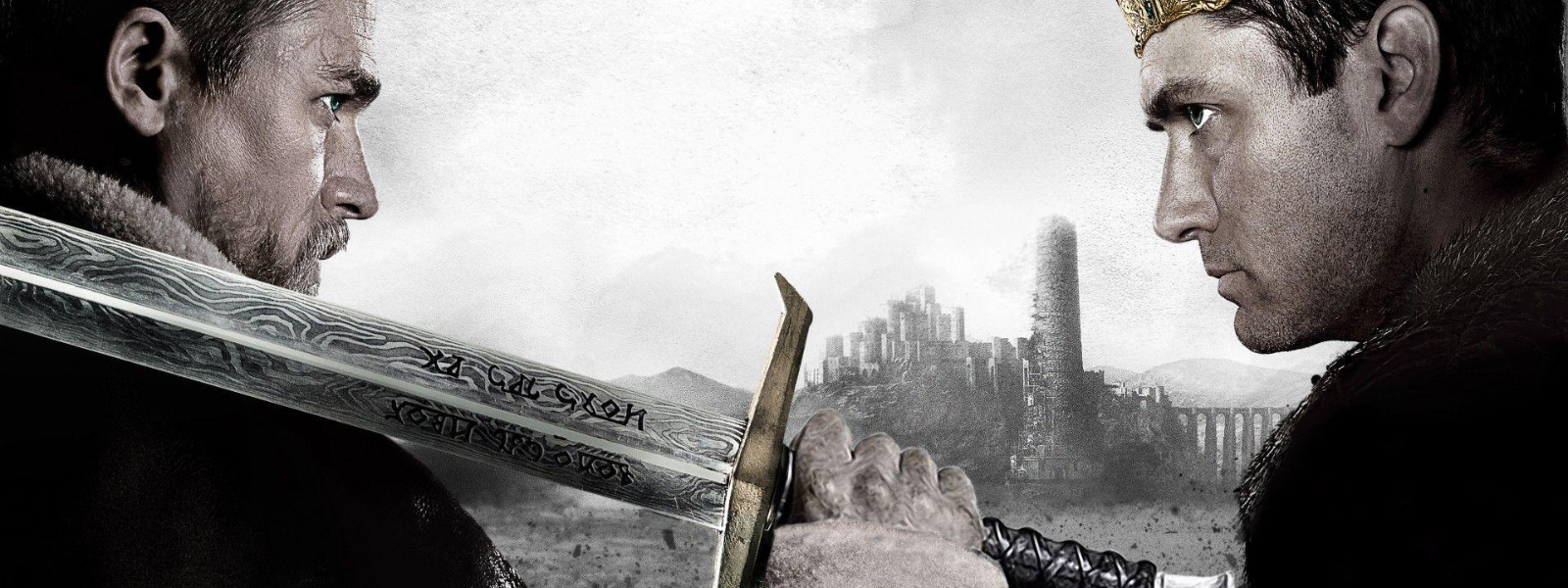
Review – King Arthur: Legend of the Sword
Director – Guy Ritchie
Starring – Charlie Hunnam, Jude Law, Eric Bana, Àstrid Bergès-Frisbey, Annabelle Wallis, Aidan Gillen and Tom Wu
Runtime – 2 hours and 6 minutes
Release date – 19th May 2017
Certificate – 12
Plot – Arthur learns about his royal lineage after he pulls the Excalibur, a magical sword, from a stone. Along with Sir Bedivere, he sets out to destroy King Vortigern, who had killed his father.
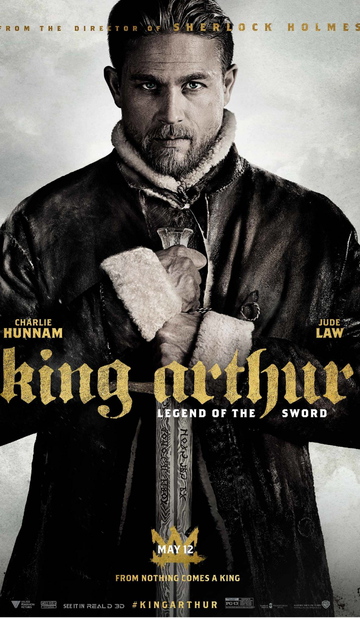
If you go into King Arthur: Legend of the Sword expecting a traditional, by the numbers retelling of the legendary King Arthur story, you are probably going to leave disappointed. This is not particularly interested in being the grand historical fantasy you might expect from the title. Instead, imagine RocknRolla or Snatch with a King Arthur painting thrown over the top and you are much closer to what Guy Ritchie is going for. This is King Arthur put through the full Guy Ritchie filter, complete with fast talking characters, sarcastic humour, rapid editing and a swagger that feels completely removed from the usual interpretations of the legend. As long as you know exactly what you are getting into beforehand, there is definitely fun to be had here.
Charlie Hunnam initially struck me as quite an unconventional choice for the titular character, but within the context of Ritchie’s version of this story, he absolutely works. This Arthur is suave, sarcastic, cocky and more than capable of handling himself when things turn violent. He feels less like the noble future king we are accustomed to seeing and more like someone who could have wandered straight out of one of Ritchie’s London crime movies. That actually makes sense considering this iteration of Arthur is raised in a brothel and grows up on the streets of Londinium. Hunnam has the charisma necessary to sell that interpretation, and you certainly get the impression that Arthur is someone you would rather have on your side than against you.
That approach gives Legend of the Sword a personality that separates it from practically every other King Arthur adaptation, and I have to give Ritchie credit for committing to it. There are sequences where Arthur and his friends are talking over one another, explaining events while we rapidly cut between different points in time, and it is unmistakably a Guy Ritchie movie. Whether that style belongs in a medieval fantasy is going to come entirely down to personal taste, but I would rather see a filmmaker put their own stamp on familiar material than simply make another safe retelling of a story we have seen countless times before.
The problem is that Ritchie’s trademark editing can also become one of the movie’s biggest weaknesses. Like many of his films, everything moves incredibly quickly, with rapid cuts and sequences designed to throw information at you at a ridiculous pace. Sometimes it works brilliantly and gives the movie an infectious energy. Other times, it can be genuinely jarring. There are moments where it feels as though the film is desperately trying to get to the next major set piece rather than allowing what is currently happening to settle. The result is a movie that rarely feels boring, but occasionally feels like someone has pressed fast forward.
That becomes particularly frustrating because I am convinced there is a three hour version of this movie sitting on a hard drive somewhere. Nowhere is that more obvious than Arthur’s journey into the Darklands. This should be a major moment in his development. Arthur is sent into this dangerous environment to confront his fears, face his demons and finally begin understanding how to control the power of Excalibur. Instead, we get incredibly quick and shaky glimpses of Arthur being attacked and fighting enormous creatures before the whole thing seems to be over within a couple of minutes. Why? The Darklands are visually interesting, dangerous and perfectly suited to being Arthur’s defining trial, yet the movie barely gives us an opportunity to experience them.
I would have happily sacrificed some of the spectacle later in the film to spend considerably more time there because Arthur learning to wield Excalibur should feel earned. The sword itself is one of my favourite elements of the movie. Ritchie does not treat Excalibur as simply a legendary blade that happens to belong to the rightful king. When Arthur properly unleashes it, the thing feels ridiculously powerful. Time slows down, Arthur tears through enemies at an almost superhuman speed and suddenly everyone standing in front of him has made a very poor life decision. There is an enormous sense of power behind the sword, and the sequences where Arthur completely lets loose with it are some of the most entertaining in the entire movie. It almost feels like Arthur has discovered a cheat code.
That is exactly why I wanted more from his journey towards mastering it. Arthur learning to use Excalibur should be the culmination of a difficult physical and emotional trial where he is forced to accept his past and understand who he is supposed to become. Instead, the movie rushes through much of that development so it can get Arthur back into the main story. Excalibur is incredibly entertaining once Arthur is capable of using it, but the journey towards reaching that point never carries quite the weight it should. There is a great character arc hiding in here somewhere, but Ritchie seems far more interested in how cool Arthur looks swinging the sword than exploring what being able to wield it actually means to him.
The fantasy elements surrounding all of this are equally excessive, and I mean that as a compliment. Legend of the Sword goes considerably bigger and stranger than I remembered. We have giant war elephants, monstrous creatures, enormous snakes, mages, supernatural powers, the Darklands and a magical sword capable of turning Arthur into a medieval wrecking ball. At times it feels less like a traditional King Arthur adaptation and more like Ritchie has been given access to a fantasy toy box and decided to throw everything onto the screen at once. It should be ridiculous, and occasionally it absolutely is, but I admire how committed the movie is to its own madness.
It also makes the rushed nature of the Darklands even more frustrating because this world clearly has so much more to offer. There are glimpses of creatures, locations and mythology that suggest a much larger fantasy world exists beyond what we are being shown. Rather than slowing down and allowing us to explore it alongside Arthur, the movie keeps sprinting forward. There is enough material here to fill several films, which was obviously the intention, but sometimes Legend of the Sword feels so preoccupied with establishing the scale of its universe that it forgets to properly explore the interesting things already sitting directly in front of us.
Jude Law also deserves considerably more credit as Vortigern because he clearly understands exactly what kind of villain this movie needs. He is cruel, theatrical, power hungry and increasingly unhinged as Arthur becomes a greater threat to his rule. Law never feels like he is sleepwalking through the role either. He completely commits to Vortigern’s desperation for power and gives the character an appropriately nasty presence whenever he appears. There are moments where the movie allows Vortigern’s actions to become surprisingly dark, particularly through the sacrifices he is willing to make to maintain and increase his power.
The issue is that the eventual confrontation between Arthur and Vortigern becomes another example of the movie choosing spectacle over substance. The final battle certainly looks impressive, with the film embracing the full power of Excalibur and pushing its fantasy elements as far as possible, but by that point it becomes another enormous CGI showdown. Considering how personal the conflict between these two characters should be, I wanted their final confrontation to carry more emotional weight. Instead, the movie once again seems more interested in giving us an impressive visual than allowing the characters underneath all that spectacle to take centre stage.
That really sums up King Arthur: Legend of the Sword as a whole because this is very much style over substance. There are some fantastic visuals, entertaining action sequences and moments where Ritchie’s direction gives the movie a huge amount of personality, but there is always a feeling that something is missing underneath it all. Strangely, though, that is also where I find myself conflicted because I can list plenty of things this movie gets wrong, yet I was rarely bored watching it. The pacing is rushed, the character development needed more room and huge portions of the mythology feel underexplored, but there is almost always something entertaining happening on screen.
That contradiction is probably the reason I find the movie easier to enjoy than it is to recommend. Every time I start becoming frustrated by how quickly it races through something interesting, Ritchie throws another stylish action sequence, sarcastic exchange or completely ridiculous fantasy creature onto the screen and pulls me back in. It is messy, excessive and occasionally feels like several different movies fighting for control, but it also has an energy that is difficult to dislike. There are plenty of technically better King Arthur movies out there, but I cannot think of many that have this much swagger.
My biggest complaint, however, is something incredibly minor in terms of the actual movie, but I cannot ignore it. Why on earth is David Beckham in this? Beckham appears as one of the King’s guards during the sword in the stone sequence and immediately took me straight out of the movie. It is such a bizarre cameo because you are suddenly no longer looking at a character. You are looking at David Beckham in medieval armour. Beckham is a footballing icon, but acting? Stay in your lane, mate.
Despite my criticisms, I cannot pretend I did not have fun with this movie. The action is entertaining, Excalibur is treated like an almost ridiculously powerful weapon and Hunnam carries the movie with enough charisma to make this version of Arthur enjoyable to follow. There is also something fascinating about simply seeing what Guy Ritchie would do when handed a legendary medieval tale and a blockbuster budget. The answer, apparently, is to make a medieval gangster movie with giant elephants, enormous snakes, magical swords and Jude Law looking increasingly furious. I cannot say there are many other King Arthur movies like it.
It is also painfully obvious that this was never intended to be the end of the story. The final act begins positioning Arthur for further adventures and you can practically see the pieces being moved into place for a much larger franchise. The frustrating thing is that Legend of the Sword sometimes seems more concerned with where this version of King Arthur could go next than making the most of where he is right now. There is enough mythology, character development and world building crammed into this movie for several stories, yet so much of it is rushed through in preparation for sequels that ultimately never arrived.
And that leaves me with a strange feeling because, despite enjoying the movie, I cannot say I was overly disappointed that those sequels never happened. I would have watched another one out of curiosity, especially to see Ritchie explore more of this bizarre fantasy world, but the ending did not leave me desperate for the next chapter. Perhaps that is the biggest problem with trying so hard to launch a franchise. You can spend all the time you want teasing the adventures still to come, but first you have to make the audience desperate to see them.
Overall, King Arthur: Legend of the Sword is a fun, messy and undeniably stylish action fantasy that works best when you stop expecting it to behave like a King Arthur movie. Charlie Hunnam is surprisingly well suited to this unconventional Arthur, Jude Law throws himself into being a wonderfully nasty villain, Excalibur feels genuinely powerful and Guy Ritchie fills the screen with enough fantasy madness to make his interpretation stand apart from everything that came before it. Unfortunately, the frantic pacing, jarring editing and obsession with spectacle mean some of its most interesting ideas never get the time they deserve.
There is a better version of King Arthur: Legend of the Sword buried somewhere inside this movie, perhaps even that imaginary three hour cut I am convinced exists. A version that spends longer in the Darklands, makes Arthur’s mastery of Excalibur feel truly earned and allows this enormous fantasy world to breathe. Instead, we have a movie that constantly races towards its next big moment. It is style over substance, absolutely, but sometimes style can still be a hell of a lot of fun. This is nowhere near my favourite interpretation of King Arthur, but it might just be the only one that can accurately be described as Snatch with swords, giant elephants and a magical superweapon. And strangely enough, that is exactly why I enjoyed it.
Well I agree with your review not the best King Arthur film for me it’s the Clive Owen version by far my favourite.