


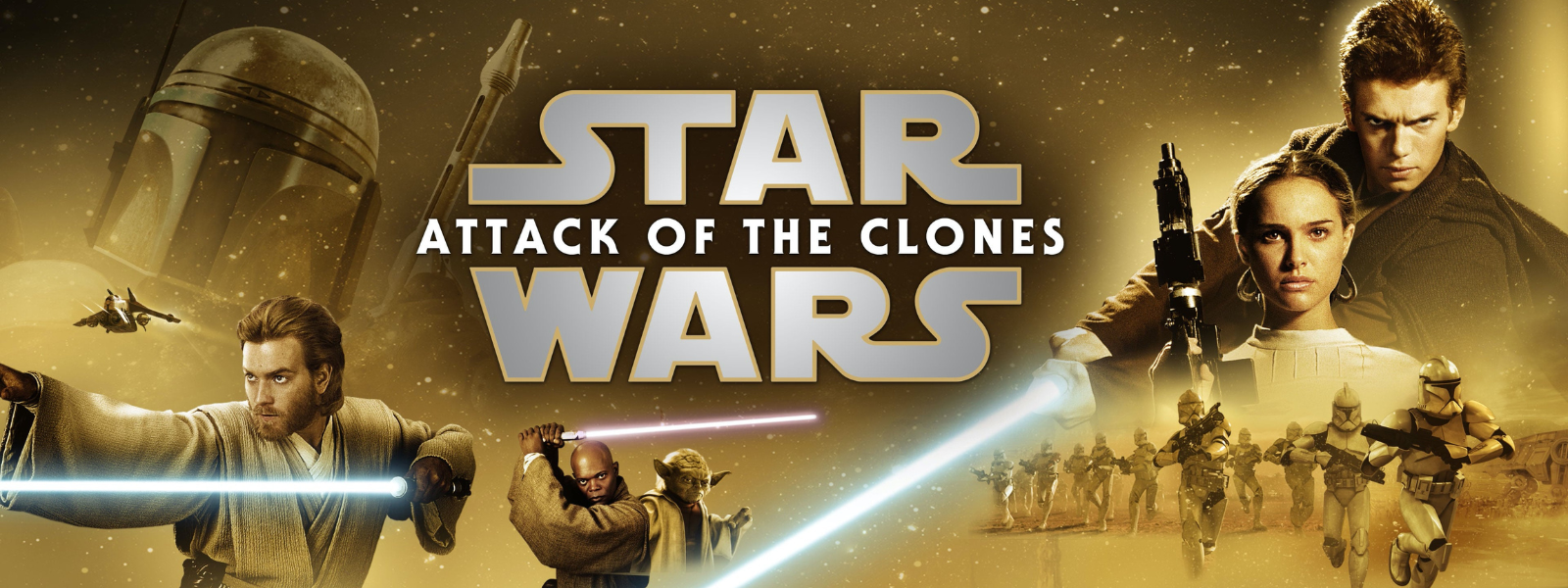
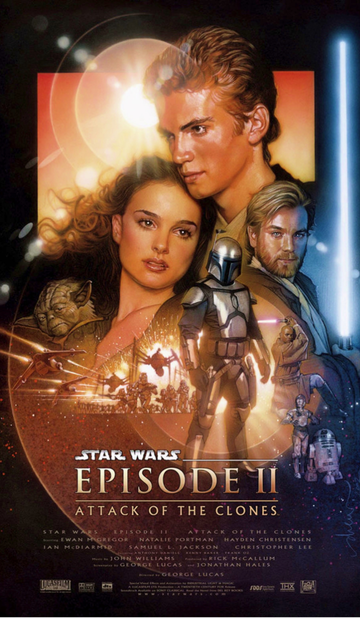
Review – Star Wars: Episode II – Attack of the Clones
Director – George Lucas
Starring – Hayden Christensen, Ewan McGregor, Natalie Portman, Christopher Lee, Ian McDiarmid, Samuel L. Jackson and Temuera Morrison
Runtime – 2 hours and 22 minutes
Release date – 16th May 2002
Certificate – PG
Plot – While pursuing an assassin, Obi Wan uncovers a sinister plot to destroy the Republic. With the fate of the galaxy hanging in the balance, the Jedi must defend the galaxy against the evil Sith.
REVIEW:
For a film that sets up the fall of Anakin Skywalker, Attack of the Clones should be gripping… instead, it’s a struggle. There’s no getting around it, this is an ugly looking movie. But oddly enough, that’s not entirely a criticism. There’s a deliberate industrial feel running throughout, from the pristine, sterile cloning facilities on Kamino to the rusted, chaotic droid factories on Geonosis. It gives the film a unique identity, even if it’s not always pleasant to look at. This is a galaxy that feels manufactured and cold, which does tie into the wider themes, even if the execution elsewhere lets it down.
I’m going to be saying this a lot throughout this review, but the script is dreadful. The dialogue feels clunky and unnatural from the very beginning, with conversations that rarely resemble how real people speak. Characters often sound like they are simply reciting information rather than interacting with each other. And it doesn’t just feel awkward, it actively damages the emotional core of the film. The more time you spend with these characters, the more the dialogue pulls you out of the experience, until it starts to completely undermine the story it is trying to tell.
This is most noticeable with Anakin and Padmé, whose relationship is supposed to be one of the central plot threads. Their conversations are painfully awkward, their chemistry feels forced, and their emotional connection never feels believable. I don’t blame Hayden Christensen or Natalie Portman for this either, as I think many actors would have struggled with this material. The dialogue is clearly intended to show Anakin as emotionally unstable, someone whose anger and lack of control is pushing him towards the dark side. But instead of coming across as tragic or complex, it makes him feel immature, uncomfortable to watch, and at times borderline creepy.
Moments that should carry emotional weight instead feel forced or unintentionally awkward. Anakin and Padmé’s first kiss comes out of nowhere and lands with no impact. Padmé declaring her love before the arena sequence should be a powerful turning point, but it feels so unnatural that it becomes distracting rather than moving. There is also the lingering issue of their age difference, something I touched on in my review of Star Wars: Episode I – The Phantom Menace. If the characters had been closer in age from the beginning, perhaps this relationship would feel more believable. As it stands, it is one of the film’s biggest weaknesses.
Even more frustrating is how this weak dialogue affects Anakin’s overall arc. His descent towards the dark side should be compelling, but it never quite lands the way it should. The moment with his mother is genuinely powerful, and his reaction to her death, followed by his massacre of the Tusken Raiders, is dark and unsettling. Hearing him admit that he killed not just the men, but the women and children as well should be a defining turning point. Instead, it is brushed aside far too quickly, and the fact that Padmé still falls for him after this is baffling. This should have been a key moment in shaping the future of Darth Vader, but it feels underdeveloped.
That said, not everything falls flat. Ewan McGregor continues to be excellent as Obi Wan Kenobi and is easily the best part of the prequel trilogy. He brings a level of charm and presence that the rest of the film often lacks. Despite the constant frustration between Obi Wan and Anakin, you can still feel a believable brotherly bond underneath it all. It is one of the few relationships in the film that actually works.
Obi Wan’s storyline is also where the film is at its strongest. His investigation into the clone army adds intrigue, and his encounter with Jango Fett leads to one of the film’s standout sequences. The space battle through the asteroid field is genuinely thrilling, with the seismic charges providing a brilliant piece of sound design. His Jedi starfighter is also a great addition, and moments like this show glimpses of what the film could have been.
Visually, the film is a mixed bag. While the industrial aesthetic works in places, the heavy use of green screen often lets it down. Many environments, particularly inside the Jedi Temple and Palpatine’s office, look dated and artificial, almost like early video game graphics. It constantly pulls you out of the world. That said, there are small details that stand out in a positive way, such as seeing R2-D2 climbing stairs in the background. It is a small touch, but one that adds a bit of charm and answers a long standing question.
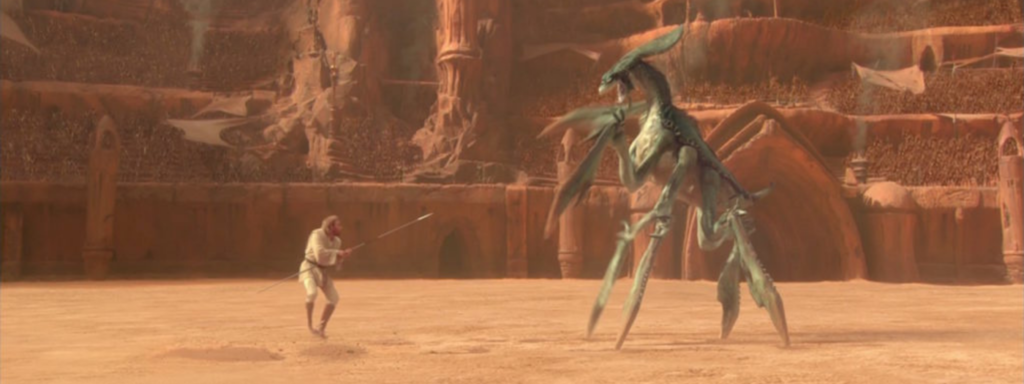
From the arena battle on Geonosis onwards, the film becomes far more enjoyable. The action finally delivers, with strong creature design and a real sense of scale. Seeing the Jedi arrive in force, led by Mace Windu, is a highlight, and Samuel L Jackson brings real presence to the role. The battle sequences are worth the wait, even if it takes a long time to get there. Obi Wan taking down the Acklay is my favourite moment in the film, as it perfectly showcases his skill and composure as a Jedi.
There are also important pieces of world building here, with the introduction of the clone army giving strong stormtrooper vibes, along with early designs that hint towards the Empire, Star Destroyers, and even the Death Star. However, some decisions remain baffling, particularly giving Jar Jar Binks the responsibility of granting Palpatine emergency powers. After the criticism of his role in Episode I, reducing his screen time makes sense, but making him central to such a pivotal moment is a strange choice.
By the time we reach the final duel with Count Dooku, the film struggles again. Obi Wan and Anakin are taken down far too easily, and while Yoda’s fight with Dooku is visually interesting, it does not come close to the intensity of the duel in Episode I. Attack of the Clones often feels longer than it is, and at times it can be a chore to sit through. There are good moments here, particularly in the final act, but they are not enough to carry the film as a whole.
For a prequel trilogy which is supposed to show the birth of the greatest movie villain of all time, Attack of the Clones makes him seem less scary, which hurts more to a Star Wars fan than this movies terrible script. There are flashes of what this film could have been, but they are buried under weak dialogue, awkward character moments, and inconsistent pacing. For me, this is clearly the weakest entry in the franchise, just edging out Episode I.
Agree with your review not the best .